
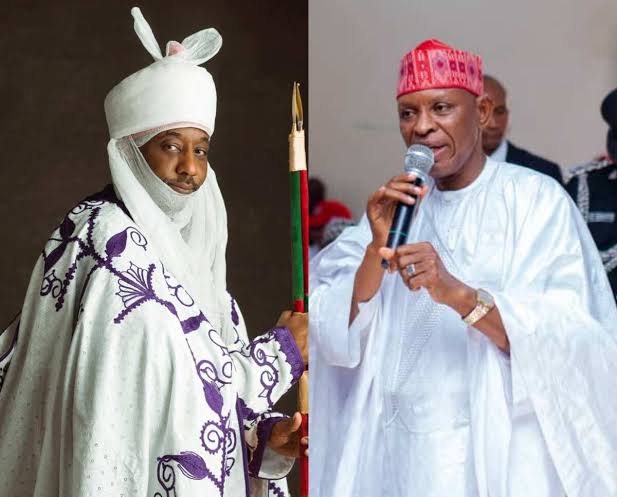


COURT STOPS REINSTATEMENT OF MOHAMMED SANUSI AS EMIR OF KANO STATE.
In a significant legal development, the courts have halted the reinstatement of Mohammed Sanusi II as the Emir of Kano State. This decision marks a pivotal moment in the ongoing saga surrounding the former emir’s deposition and the political and legal maneuvers that have followed. This blog post delves into the background, the court’s decision, and its broader implications for Kano State and Nigeria.
BACKGROUND: THE DEPOSITION OF MOHAMMED SANUSI II
Mohammed Sanusi II, a former Governor of the Central Bank of Nigeria, ascended to the throne of the Emir of Kano in June 2014. His tenure was marked by efforts to modernize the emirate, as well as outspoken criticism of government policies, particularly on economic matters. His vocal stance often put him at odds with political authorities.
In March 2020, Sanusi was deposed by the Kano State Government, citing allegations of insubordination and disrespect to lawful authorities. His removal was widely perceived as politically motivated, given his frequent critiques of the state and federal governments. Following his deposition, Sanusi was initially placed under house arrest before relocating to Lagos and then Kaduna, where he continues to be a prominent public figure.
LEGAL BATTLE: SEEKING REINSTATEMENT.
Sanusi’s deposition sparked a series of legal battles. His supporters and legal team argued that his removal was unconstitutional and violated due process. They maintained that the procedure followed did not adhere to the traditional or legal standards required for deposing an emir.
In February 2021, a Federal High Court in Abuja declared Sanusi’s banishment and house arrest as unlawful and awarded him damages. This ruling reinvigorated his supporters’ efforts to challenge his deposition and seek his reinstatement as the Emir of Kano.
COURT’S DECISION: HALTING REINSTATEMENT.
In a recent ruling, the court decided to stop the reinstatement of Mohammed Sanusi II as the Emir of Kano. The decision has significant legal and political implications. Here, we explore the reasons behind the court’s ruling and its potential impact.
LEGAL GROUNDS FOR THE DECISION.
The court’s ruling to halt the reinstatement hinges on several key legal arguments:
1. Jurisdictional Issues: The court examined whether it had the appropriate jurisdiction to reinstate Sanusi. This involves complex considerations of both constitutional law and traditional authority.
2. Procedural Irregularities: The court scrutinized the procedural aspects of Sanusi’s deposition and the processes involved in any potential reinstatement. This includes evaluating whether all legal and traditional protocols were followed during his removal and in the subsequent legal actions.
3. Precedent and Legal Consistency: The court also considered previous legal precedents and the need to maintain consistency in the interpretation of laws governing traditional institutions and chieftaincy titles.
IMPLICATIONS OF THE RULING.
The decision to halt Sanusi’s reinstatement carries significant implications for various stakeholders:
1. For Mohammed Sanusi II: The ruling is undoubtedly a setback for Sanusi and his supporters. It complicates his path to reclaiming the throne and may prompt a reassessment of his legal strategy.
2. For Kano State Government: The ruling supports the state government’s actions, at least temporarily, and validates their decision to depose Sanusi. It also potentially strengthens the position of the current emir, Alhaji Aminu Ado Bayero, by reducing uncertainty around his tenure.
3. For the Judiciary: The court’s decision underscores the judiciary’s role in resolving complex disputes involving traditional institutions. It also highlights the challenges courts face in balancing legal principles with the intricate dynamics of cultural and traditional practices.
4. For the Traditional Institution: The ruling impacts the broader traditional institution in Nigeria, raising questions about the balance of power between traditional rulers and political authorities. It also sets a precedent for how similar cases might be handled in the future.
POLITICAL AND SOCIAL REACTIONS.
The court’s decision has elicited a range of reactions from different quarters. Political analysts, legal experts, and social commentators have weighed in on the implications of the ruling.
POLITICAL REACTIONS.
Political figures from various spectrums have responded to the court’s decision. Supporters of the Kano State Government have hailed the ruling as a victory for due process and the rule of law. They argue that it reaffirms the government’s authority to manage traditional institutions within its jurisdiction.
Conversely, supporters of Mohammed Sanusi II view the decision as a politically motivated attempt to marginalize a vocal critic of the government. They argue that the legal processes have been influenced by political considerations, and they remain determined to continue their legal fight.
SOCIAL REACTIONS.
On social media and in public discourse, opinions are divided. Some see the ruling as a necessary step to ensure stability and respect for legal procedures. Others view it as an injustice to a reform-minded leader who sought to modernize the emirate and champion social and economic reforms.
FUTURE PROSPECTS: WHAT’S NEXT FOR SANUSI AND KANO STATE?
The court’s decision to stop the reinstatement of Mohammed Sanusi II raises several questions about the future of the emirate and Sanusi’s role in Nigerian society.
SANUSI’S FUTURE.
Despite the legal setback, Sanusi remains a prominent figure in Nigeria. His expertise in economics and governance continues to make him a respected voice on national and international platforms. It is likely that he will continue to influence public discourse and policy debates, even if he is not reinstated as the Emir of Kano.
IMPACT ON THE EMIRATE.
The ruling also affects the traditional institution of the Kano Emirate. It brings a degree of stability to the current leadership but also underscores the ongoing tensions between traditional authority and political power. The outcome of this legal battle may influence how other traditional institutions navigate their relationships with state governments.
CONCLUSION
The court’s decision to halt the reinstatement of Mohammed Sanusi II as the Emir of Kano State is a significant development with far-reaching implications. It highlights the complex interplay between legal principles, traditional authority, and political power in Nigeria. As the legal and political saga continues, it remains to be seen how these dynamics will evolve and what the future holds for Sanusi, the Kano Emirate, and the broader traditional institution in Nigeria.
This ruling serves as a reminder of the importance of due process and the rule of law in resolving disputes involving traditional institutions. It also underscores the need for a careful balancing of interests to ensure stability and respect for cultural heritage in Nigeria’s evolving political landscape.